The Math Your Child Is Already Learning — And Why It Starts Earlier Than You Think
Most parents assume math starts with counting. It doesn’t. By the time a child can recite numbers to ten, their brain has already been building mathematical understanding for years — through touch, movement, comparison, and pattern recognition.
The preschool years aren’t preparation for math. They’re when the real foundation gets laid.
Why Hands-On Math Works Better Than Flashcards at This Age
A 4-year-old can memorize that 3 plus 2 equals 5. What they can’t do yet — without concrete experience — is understand what that means. Abstract symbols are meaningless until a child has physically handled the quantities behind them enough times that the abstraction makes sense.
This is why the Montessori approach to early math is built entirely around physical materials. Number rods let children feel the difference in length between 1 and 10. Golden bead chains make the jump from units to tens to hundreds something a child can hold in their hands, carry across a room, and lay out on the floor. The understanding isn’t explained — it’s experienced, repeatedly, until it becomes intuitive.
Research from the University of Denver found that early math skills at kindergarten entry are one of the strongest predictors of academic achievement at age 15 — stronger than early reading skills, attention, or social development. The window between 3 and 6 is not one to drift through.
What Early Math Actually Looks Like in a Preschool Classroom
Early math isn’t a subject in a Montessori preschool — it’s woven through the entire day. A child sorting objects by size is building classification skills. A child setting the table for snack is practicing one-to-one correspondence. A child arranging the shelves is working with order and sequence.
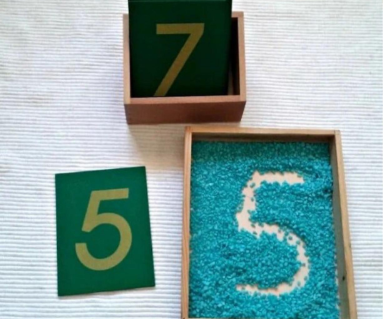
Formal Montessori math materials introduce number concepts in a specific sequence: quantity before symbol, concrete before abstract, simple before complex. Children work with number rods and sandpaper numerals before they ever write a number. They build the decimal system with golden beads before they encounter a place value chart. Each step has a physical anchor that the next step builds on.
By the time children in a well-run Montessori program reach kindergarten, many are working comfortably with addition, subtraction, and early skip counting — not because they were pushed, but because the sequence made each step feel natural. You can explore how this progression works in detail through the Montessori curriculum at Brainy Bees.
The Skills Parents Don’t Realize Are Math
Parents often tell us their child “isn’t doing math yet” at pickup — then describe a morning where their child spent 20 minutes sorting coloured beads by size, building a pattern with wooden blocks, and carefully counting out napkins for the lunch table.
That’s all math. Specifically:
- Sorting and classification — the cognitive foundation for data, sets, and categorization
- Patterning — the basis for algebraic thinking, which begins earlier than most people realize
- One-to-one correspondence — understanding that each object gets exactly one count, which precedes all arithmetic
- Spatial reasoning — how objects relate in size, shape, and position, strongly linked to later geometry and problem-solving
Children who enter kindergarten with strong spatial reasoning and classification skills outperform peers in formal math assessments even when those peers have more number drill under their belt. The foundation matters more than the flashcards.
What I Tell Parents Who Want to Support Math at Home
The single most useful thing parents can do is narrate quantity in everyday life — not quiz their child, but observe out loud. “We need four plates — let’s count them out together.” “Which pile has more?” “Your piece is bigger than mine — look.” That running commentary builds number sense naturally, without pressure.
What I’d steer parents away from is math apps and counting drills before age 5. They teach symbol recognition without understanding. A child who can tap the right answer on a screen hasn’t necessarily grasped the concept behind it. Hands-on, real-world quantity experience — cooking, building, sorting, comparing — does more for early math development than any screen-based program.
At Brainy Bees Montessori, our Bright Bees preschool program gives children daily access to the full Montessori math sequence in a prepared environment where they can work at their own pace, revisit materials as many times as they need, and move forward when they’re genuinely ready — not when a schedule says it’s time.
Math Confidence Is Built Early — or It Isn’t
Math anxiety is real, it’s common, and it almost always has roots in early childhood. Children who were pushed past their readiness, made to feel wrong in front of peers, or drilled on symbols before they understood quantity often carry that discomfort for years.
The inverse is also true. Children who build genuine understanding through physical experience — who feel the weight of ten golden beads versus one, who can lay out a number rod and see why 7 is bigger than 4 — develop a relationship with numbers that feels solid rather than fragile. That confidence doesn’t just help in math class. It shapes how children approach any problem that feels hard.
For families thinking about summer as a way to reinforce these skills before kindergarten, our Montessori Summer Camp for ages 3 to 6 continues the hands-on math work in a relaxed, exploratory setting — including early STEM discovery and problem-solving activities that build on what children have already learned during the year.
FAQ
When should my child be able to count to 10 — and does it matter if they can’t yet? Rote counting to 10 typically emerges between ages 3 and 4, but reciting numbers in order is different from understanding quantity. A child who counts to 10 but can’t tell you which group has more hasn’t yet grasped number sense. Focus less on the recitation and more on whether your child understands more, less, and the same — that’s the concept that actually matters at this stage.
Is the Montessori math approach suitable for children who seem advanced in numbers? It’s particularly well suited to them. The Montessori math sequence doesn’t have a ceiling at preschool level — children who move through early materials quickly can progress naturally into multiplication, division, and fractions using the same concrete-to-abstract method. A child who is ready isn’t held back by a class pace. They simply move forward.
How do I know if my child’s preschool is actually teaching math — or just calling it math? Ask the educator what math materials your child worked with this week and what concept it was building. A strong Montessori educator can answer that specifically — “she spent time with the number rods working on quantities 1 through 7” — not just “we did counting activities.” Specificity signals genuine tracking of individual progress.
Curious about how the full math curriculum unfolds from infancy through preschool? Explore our programs or read more on the Brainy Bees blog. If you’d like to see the materials in person, book a tour at brainybees.ca or email us at info@brainybees.ca.