- +1 825 559 2337
- info@brainybees.ca
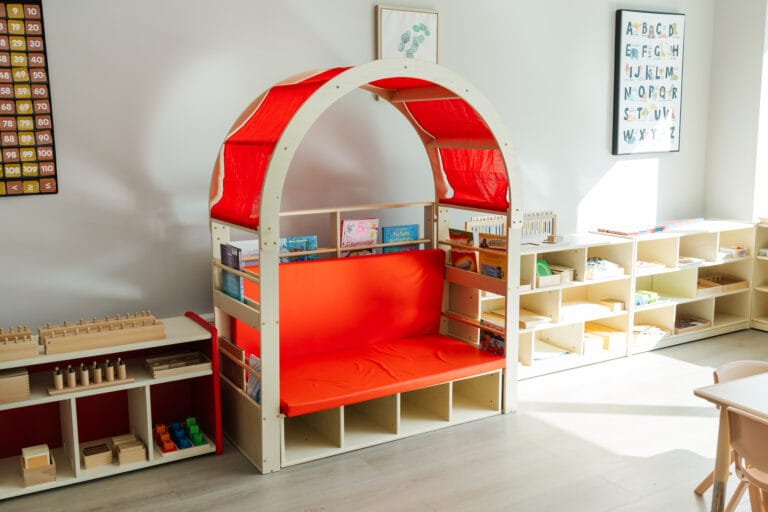
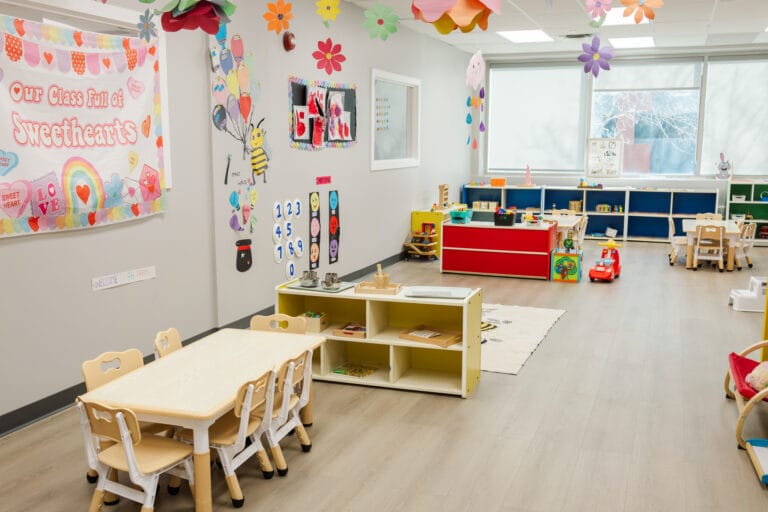
The Montessori curriculum Red Deer children experience at Brainy Bees covers six areas of development — designed for ages 0 to 6, and built around each child’s individual pace. The Montessori curriculum is a structured, research-based framework for early childhood education developed by Dr. Maria Montessori over a century of observation and refinement. Unlike a conventional preschool curriculum where a teacher delivers lessons to a group, the Montessori curriculum is delivered through a prepared classroom environment. Each material on the shelf teaches one concept, isolates one difficulty, and contains a built-in control of error so that children can discover their mistakes without being corrected by an adult.
At Brainy Bees, our Montessori curriculum in Red Deer covers six interconnected areas of development: Practical Life, Sensorial, Language, Mathematics, Geography and Culture, and Science. Every child works across all six areas, but the pace, sequence, and depth are determined by the individual child — not by the calendar or the group.
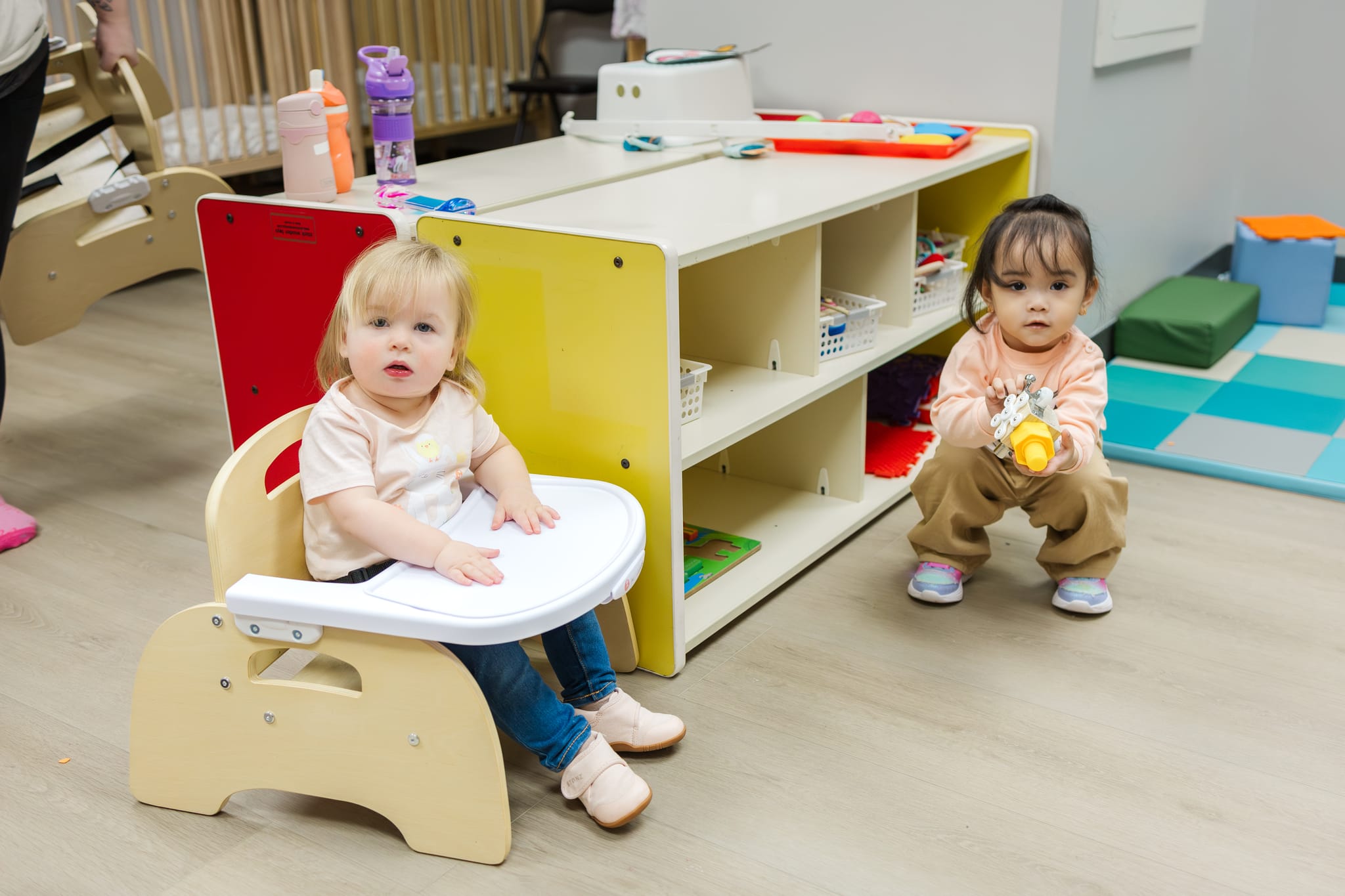
Practical Life is where every child begins, regardless of age. These activities mirror real tasks from everyday life: pouring water from one pitcher to another, spooning beans between bowls, washing a table, sweeping a floor, buttoning a dressing frame, folding a cloth.
The purpose is not to teach these tasks for their own sake. The purpose is to develop the four pillars that underpin all learning: concentration, coordination, independence, and order. A 2-year-old who pours water without spilling has solved a problem that required her full attention, precise muscle control, and a sequence of steps executed in the right order. That is not a small thing. That is the cognitive and physical infrastructure that math and reading are built on later.
In our Red Deer Montessori curriculum, Practical Life materials are made from real objects — real pitchers, real brooms, real scrubbing brushes. Children are not pretending to clean. They are cleaning.
Between birth and age six, the brain is building its foundational understanding of the physical world through the senses. The Sensorial area of the Montessori curriculum provides materials specifically designed to refine each sense in isolation.
The Pink Tower teaches dimension — ten wooden cubes graded from 1 cm to 10 cm, stacked from largest to smallest. The Color Tablets teach shade and hue. The Sound Cylinders teach pitch discrimination. The Geometric Solids teach shape recognition by touch before children ever see a geometry textbook.
Each Sensorial material isolates a single quality — size, color, sound, weight, texture — so the child’s attention is focused precisely. The control of error means children know when they have made a mistake without being told. A child who places a cylinder in the wrong hole discovers it doesn’t fit. She tries again. This self-correction is Montessori’s most important feature: it develops internal judgment rather than reliance on external approval.
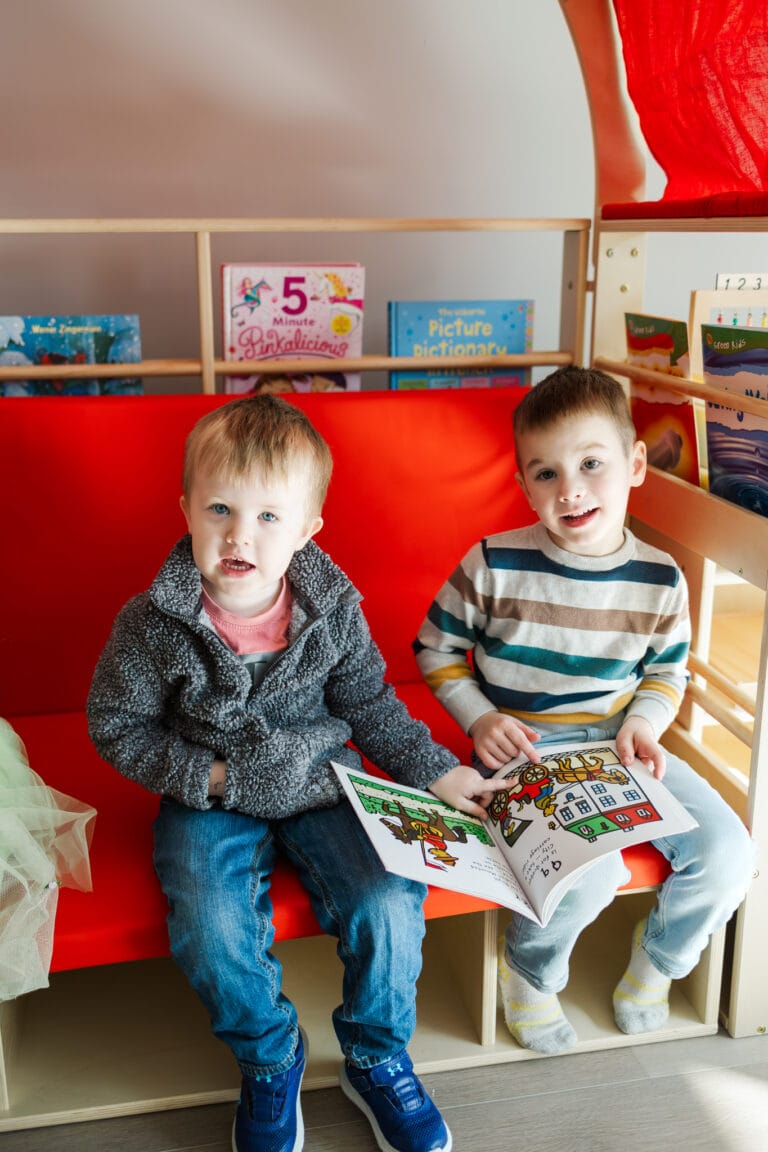
Language development in the Montessori curriculum begins with listening and speaking, then moves to phonemic awareness, reading, and writing. The sequence is important: Montessori children typically write before they read, because the fine motor control and phonetic knowledge required to construct words on paper come naturally before the ability to decode an unfamiliar text.
The key materials are sandpaper letters (each letter is traced with two fingers, engaging muscle memory alongside visual and auditory input), the moveable alphabet (wooden letters used to build words before the hand can form them), and a progression of phonetic reading books that introduce new phonemes in a controlled sequence.
By the end of our Red Deer Montessori curriculum preschool program, most children are reading simple books independently and writing recognizable sentences. This is not the result of drilling or flashcards. It is the result of three years of multi-sensory, sequential language work in the Montessori environment.
The Montessori approach to mathematics is built on a single principle: abstract symbols (numerals) must first be understood through concrete experience. A child cannot truly understand that “1000” is larger than “10” by looking at the symbols. She can understand it by holding a cube made of 1000 golden beads and comparing it to a single bead in her other hand.
The Montessori math curriculum in Red Deer progresses through a carefully designed sequence of materials. Number Rods introduce quantity. Sandpaper Numerals connect symbol to quantity. The Golden Bead Material introduces the decimal system concretely. Bead Chains allow counting into the thousands. The Stamp Game introduces the operations of addition, subtraction, multiplication, and division using colored tiles — still concrete, but moving toward abstraction.
Children who work through this sequence do not memorize math facts by rote and then forget them. They understand what the facts mean, because they built the understanding themselves, physically, before the numbers arrived.
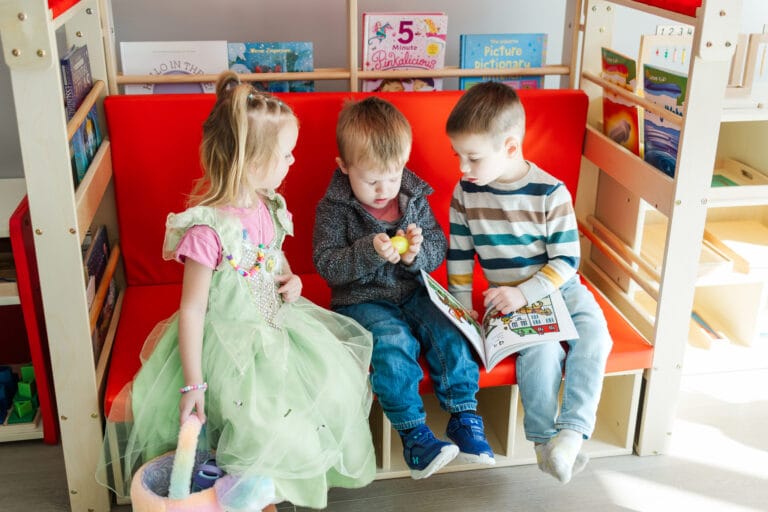
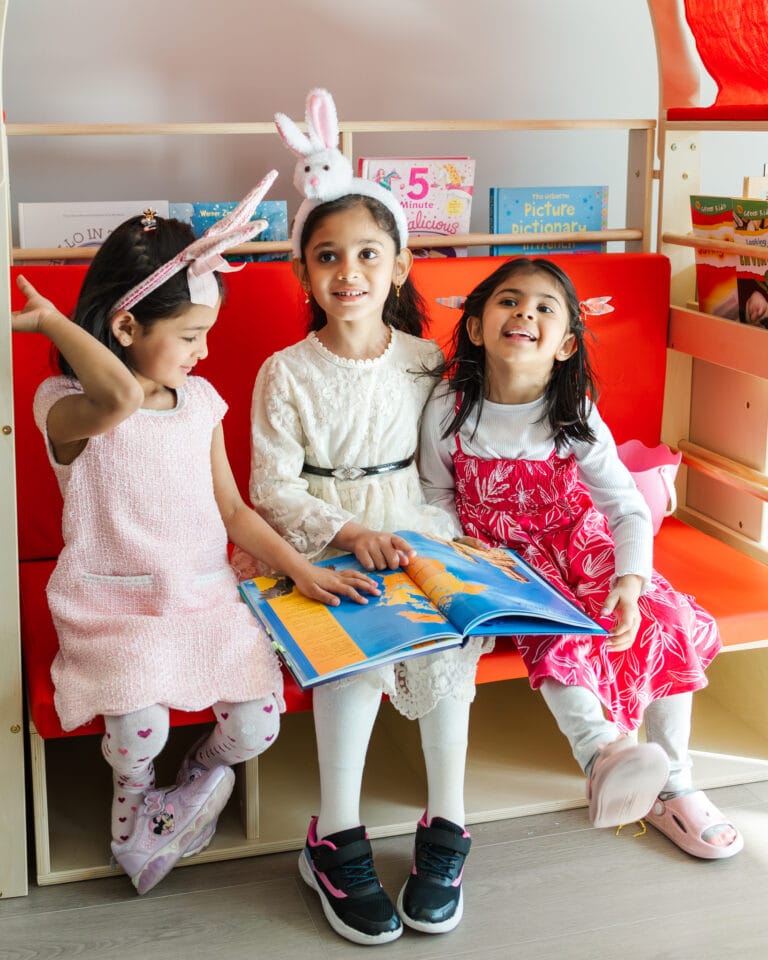
Montessori education is international in its orientation. Dr. Montessori believed that global awareness and respect for diversity were as fundamental to human development as reading and arithmetic.
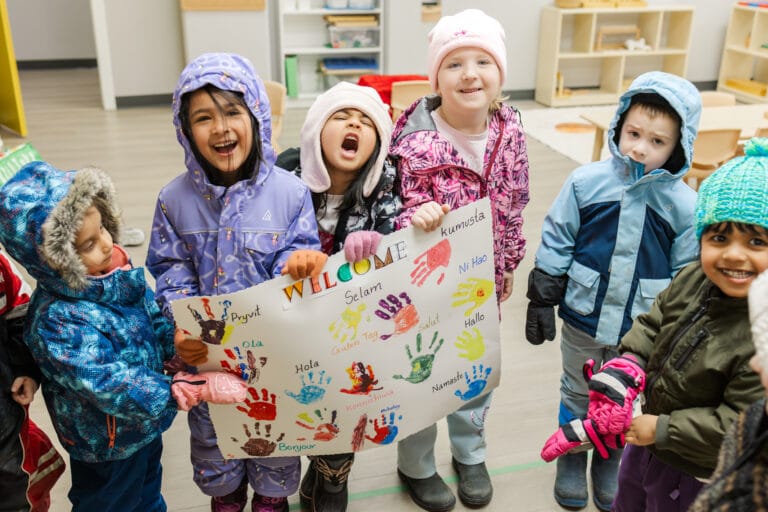
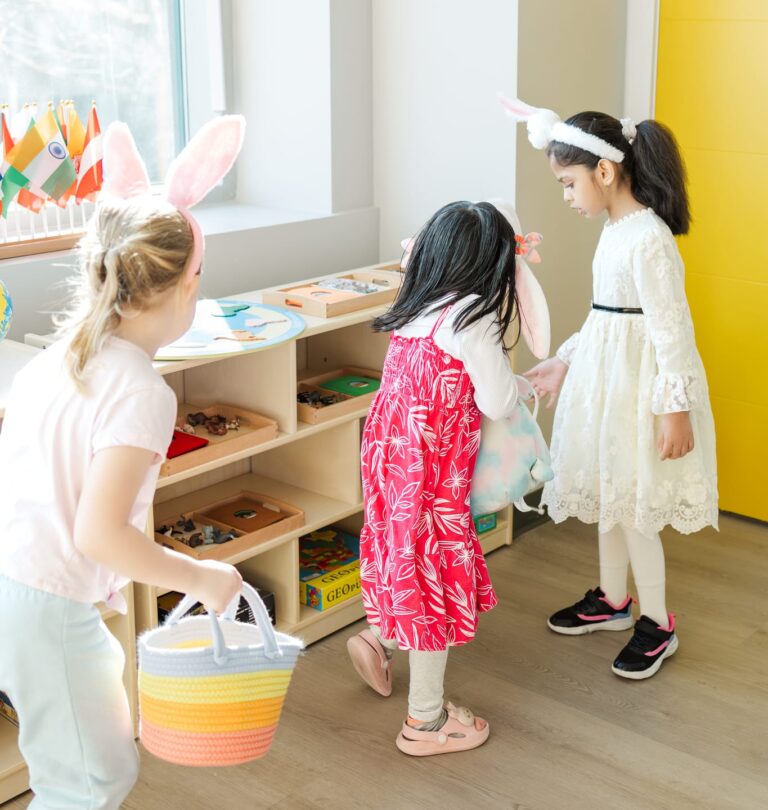
The geography and cultural studies area of our Montessori curriculum in Red Deer begins with the concrete and familiar — this is where I live, this is Alberta, this is Canada — and expands outward to continents, countries, and the variety of human experience across the globe. Children work with puzzle maps of the continents, learning to recognize shapes and names by placing and replacing wooden pieces. They explore flags, foods, clothing, music, and traditions from cultures around the world.
Cultural studies are integrated throughout the year, not reserved for designated “multicultural” weeks. The Montessori classroom is designed to feel like a reflection of the world in miniature.
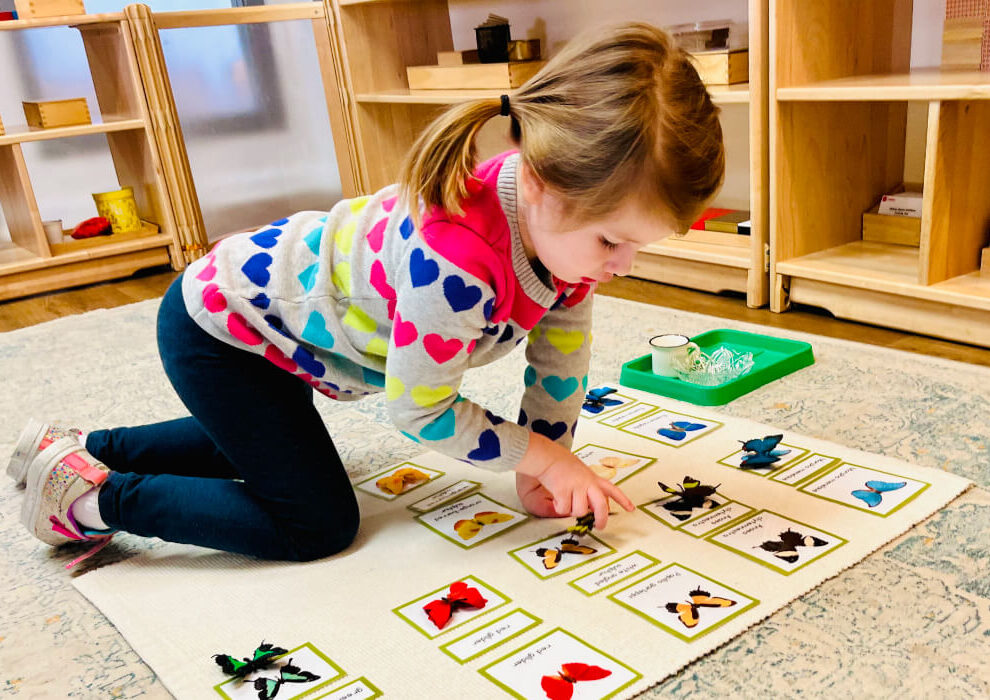
Science in the Montessori curriculum is not a subject. It is a habit of mind. Children in a Montessori classroom are scientists from the beginning: they observe before they conclude, they handle materials before they name them, and they ask questions that the environment is designed to help them answer.
The science curriculum at Brainy Bees covers three main areas: botany (plant classification, plant parts, life cycles), zoology (animal classification, vertebrates and invertebrates, life cycles), and earth science (landforms, bodies of water, the solar system). Children grow plants, care for classroom animals, sort animal figures, and conduct simple experiments with water, gravity, and light.
Science lessons in the Montessori curriculum are presented in three-part lessons: naming, recognition, and recall. A child first handles and names a material (this is a leaf, this is a stem), then is asked to identify it without the name (show me the leaf), then is asked to name it independently. This sequence mirrors how the brain stores new information.
The structure that makes the Montessori curriculum work is time. Specifically, the uninterrupted three-hour work cycle. In our Red Deer Montessori preschool program, the morning is protected. No group carpet time at 9:15. No transition bells. No interruptions. Children arrive, choose their work, and move through the classroom at their own pace for three hours.
This extended, uninterrupted time is where the concentration cycle completes. A child who is interrupted mid-activity does not develop deep focus. A child who is allowed to work until she is genuinely done — who repeats an activity twelve times, masters it, replaces it on the shelf, and moves to the next thing — develops the ability to concentrate that follows her into school, into work, into life.
This is what separates our Montessori curriculum in Red Deer from programs that use Montessori materials as enrichment activities between teacher-directed group lessons. The materials are not the curriculum. The environment, the freedom, and the time are the curriculum.
The Montessori curriculum in Red Deer at Brainy Bees is designed for children from infancy through age 6. It is not a gifted program, and it is not a remedial program. It is a developmentally appropriate framework for all children, including those with language delays, motor challenges, behavioral differences, and learning profiles that do not fit a conventional classroom.
If you have questions about whether our Montessori curriculum is right for your child, call 825-559-2337 or book a tour at our Red Deer facility at #202 4909 49 St.