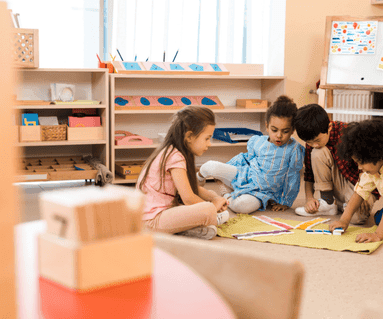
Class size debates usually happen at the high school level — overcrowded classrooms, not enough teachers, students falling through the cracks. But the research on class size is actually most compelling at the other end of the age spectrum. For children under 6, the number of kids in the room shapes almost everything about how learning happens.
This isn’t about preference. It’s about developmental biology.
What Happens to a Young Child’s Brain in an Overcrowded Room
Children between birth and age 6 are in a period of rapid neurological development. Their brains are forming connections at a rate that won’t be matched again in their lifetime. What those connections get built around — stress or security, chaos or calm — matters in ways that extend well past early childhood.
When a young child is in a large, loud, overstimulating group for hours at a time, the stress response activates. Cortisol rises. The brain shifts resources toward managing the environment rather than exploring it. Learning doesn’t stop entirely, but it narrows. A child in survival mode — even mild, low-grade survival mode — is not a child in discovery mode.
Small class sizes reduce that background noise. Not just the literal noise, but the social and sensory load that young children are still learning to process. Fewer children in the room means less competition for attention, less unpredictability, and more of the calm that makes genuine learning possible.
The Difference One Adult Can Actually Make at a Low Ratio
There’s a specific number worth knowing: the Alberta government recommends a ratio of 1 educator to 6 children for preschool-aged groups. Some programs exceed that — more children per adult, not fewer. The difference between a 1:6 ratio and a 1:10 ratio isn’t just arithmetic. It changes what’s possible in a room.
At a low ratio, an educator can observe each child individually — not just monitor the group for safety, but actually track what a specific child is working on, what they’re struggling with, what they’re ready for next. That level of attention is what makes individualized learning real rather than theoretical.
At a high ratio, the adult is managing. Keeping things from going sideways, rotating attention across too many children, and inevitably spending more time on the loudest needs rather than the quietest ones. The quiet child who is struggling with something subtle — social anxiety, a concept that isn’t clicking, a sensory sensitivity — gets less of what they need because the adult simply doesn’t have the bandwidth to notice.
How Small Classes Support Social Development Specifically
Social learning in early childhood happens through direct interaction — not observation, not instruction, but the lived experience of navigating relationships with other children. That process requires enough space and calm that children can actually read each other.
In a large group, the social environment becomes harder to parse. There’s more noise, more movement, more competition for resources, and more conflict. Children who are still developing the neurological tools to regulate their own emotions and read social cues can become overwhelmed — and overwhelmed children don’t practice social skills, they retreat from them.
Smaller groups allow children to build genuine peer relationships rather than just coexist in proximity. They learn each other’s names, preferences, and habits. They develop the kind of specific social knowledge — she gets upset when you take her work without asking, he needs a minute before he’s ready to play — that is the actual substance of early social competence.
At Brainy Bees Montessori, our age-banded classrooms are intentionally kept small enough that educators know every child as an individual — not as one of a large group. That familiarity is what allows the Montessori curriculum to be delivered the way it was designed: child by child, not class by class.
What I Notice in Children Who’ve Come From Larger Programs
When families transition to Brainy Bees from larger daycare centres, there’s a pattern I see consistently in the first few weeks. Children who seemed loud, impulsive, or hard to settle in their previous environment become noticeably calmer within a month of being in a smaller, quieter classroom.
It’s not that those children had behavioural problems. It’s that they were in an environment that was asking more of their nervous systems than their nervous systems were ready to handle. Remove the overstimulation and a lot of what looked like difficult behaviour turns out to be a reasonable response to an unreasonable environment.
That shift — from managed to genuinely settled — is one of the clearest signals that class size is doing real work. You can read more about the environment we’ve built and why it matters on our about page, or see it for yourself on a tour.
Small Classes Matter in Summer Too
One thing parents don’t always consider is whether the class size advantage carries through summer programming. Many summer camps expand their ratios significantly — more children, fewer specialized staff, a higher-energy environment that works for older kids but can be genuinely hard for preschoolers.
Our Montessori Summer Camp for children ages 3 to 6 maintains the same intentional approach to group size that runs through our year-round programs. The outdoor exploration, creative projects, and early STEM activities are designed for small groups — not delivered to a large room of children and called Montessori because there are some wooden materials on a shelf.
FAQ
How do I find out the real child-to-educator ratio at a program I’m considering? Ask for the ratio by age group, not the overall centre average. A centre might have excellent ratios in the infant room and significantly higher ratios in the preschool room — the average hides that gap. Also ask what the ratio looks like during transitions, outdoor time, and rest periods, not just during formal program time. Those are the moments ratios most often slip.
Does class size matter as much for infants as it does for older children? It matters more. Infants depend entirely on responsive caregiving — the speed and consistency with which an adult notices and responds to their cues. At a high ratio, that responsiveness is physically impossible to maintain. An infant whose signals go unread repeatedly doesn’t just miss comfort in the moment — they build an internal model of the world as unreliable. Low ratios in infant care aren’t a luxury. They’re developmentally necessary.
My child seems to do fine in larger groups — should I still prioritize class size? Children adapt to their environment, which is not the same as thriving in it. A child who appears fine in a large group may be managing rather than flourishing — staying out of trouble, following along, not causing problems. The question worth asking is whether they’re being genuinely known and challenged by an adult who has the time to notice them specifically. That’s what small class sizes make possible, and it’s often invisible until a child experiences the difference.
Want to see what a small, intentional classroom actually looks like in practice? Explore our programs or browse the Brainy Bees blog for more on early childhood development. To book a tour, visit brainybees.ca, email info@brainybees.ca, or call 825-559-2337.