Most parents focus on academics when choosing a preschool. Reading readiness, number recognition, early writing. Those things matter — but the skill that most predicts how well a child does in kindergarten and beyond isn’t academic at all. It’s the ability to get along with other people.
Social development in the preschool years isn’t a soft extra. It’s the foundation everything else is built on.
What Social Development Actually Looks Like Between Ages 3 and 5
Children don’t arrive at preschool knowing how to share, negotiate, repair a conflict, or read another child’s emotional state. Those skills are learned — slowly, through repetition, through friction, and through having adults nearby who guide without taking over.
Between ages 3 and 5, children move through distinct social stages. At 3, most play is parallel — side by side, aware of each other but not truly collaborative. By 4, cooperative play begins to emerge. Children start building shared narratives, assigning roles, and holding a joint idea together across time. By 5, most children can sustain complex social interactions, manage disagreement with words rather than reactions, and show genuine empathy toward peers.
Each of these stages requires the right environment to unfold. A rushed, overly structured day doesn’t give children the space to practice. Neither does an environment where adults constantly intervene before children have a chance to work things out themselves.
How the Montessori Environment Supports Social Growth
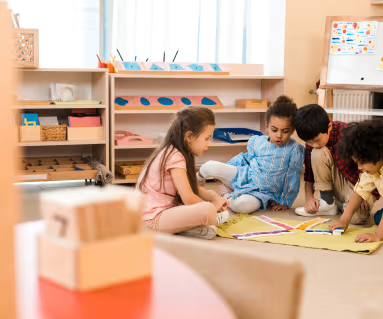
The Montessori classroom is designed to make social learning unavoidable — in the best possible way. Children work near each other, choose their activities, and navigate the natural friction of shared space and shared materials every single day.
When two children both want the same work at the same time, no adult swoops in immediately with a solution. The children are guided — gently, when needed — to work it out. That moment of negotiation, repeated hundreds of times across a school year, builds something textbooks can’t teach: the lived experience of conflict, resolution, and repair.
The Montessori curriculum at Brainy Bees intentionally weaves social development through every area of the classroom, from Practical Life activities that require turn-taking and cooperation, to group cultural studies that build appreciation for perspectives different from their own.
Why Preschool Friendships Build Skills That Last
The friendships children form at 3, 4, and 5 are not just sweet — they’re functional. Each friendship is a practice ground for reading social cues, managing emotions, and recovering from misunderstanding.
Research on early childhood development consistently shows that children with stronger peer relationships at preschool age demonstrate better self-regulation, higher academic engagement, and lower rates of anxiety in primary school. The mechanism is straightforward: children who feel socially confident approach new challenges with less fear. They ask for help more readily. They recover from setbacks more quickly.
This is one of the reasons our programs at Brainy Bees Montessori are structured around age-banded groups rather than one large mixed room. Children develop social confidence most readily when they’re working alongside peers at a similar developmental stage — close enough to understand each other, different enough to learn from each other.
What I Tell Parents Who Worry Their Child Is “Not Social Enough”
The most common concern I hear from parents of 3-year-olds is that their child plays alone, doesn’t seek out other children, or gets overwhelmed in group settings. My honest response: that’s developmentally normal for many children at that age, and the right environment changes it faster than most parents expect.
What matters isn’t whether a child walks in social. It’s whether the environment they’re in every day gives them safe, low-pressure opportunities to try. A child who spends six months watching from the edge of the room before joining in isn’t behind — they’re gathering information. A good Montessori educator knows the difference between a child who needs time and a child who needs support, and responds accordingly.
At Brainy Bees Montessori, we’ve seen children described as “shy” by their parents become confident, sought-after playmates within a single school year. Not because we pushed them — because we gave them a predictable, respectful environment where taking social risks felt safe enough to try.
Social Learning Doesn’t Stop When School Does
One thing parents often don’t consider is how much social development happens outside formal program hours. The Before and After School Care environment — and summer programming — are extensions of the same social laboratory the classroom provides.
Our Montessori Summer Camp for children ages 3 to 6 is built around exactly this. Group projects, outdoor exploration, creative collaboration, and the kind of unstructured peer time that lets children practice everything they’ve been building during the school year. For children heading into kindergarten in the fall, a summer of strong peer interaction is one of the best preparation tools available.
FAQ
How can I support my child’s social development at home during the preschool years? The most effective thing parents can do is resist solving social problems too quickly. When your child reports a conflict with a friend, ask questions before offering answers — what did you say? what did they do next? what do you think you could try? That process of walking through a social situation with language builds the same reflective skills the Montessori classroom is developing every day.
My child is starting preschool and has never been in group care before. Should I be worried about the social adjustment? A first group care experience at 3 is very common and very manageable. The adjustment period varies — some children settle in two weeks, others take two months. What matters is that the program has a genuine onboarding process and educators who track how individual children are settling, not just whether the group is running smoothly. Ask about this specifically on your tour.
At what age should children be able to manage conflict without adult help? Full independence in conflict resolution develops well past the preschool years — most adults are still working on it. What you’re looking for at ages 4 and 5 is the beginning of verbal negotiation: using words instead of physical reactions, pausing before escalating, and being able to accept a compromise. Children in environments that practice these skills daily show meaningful progress within a single school year.
Want to see how social development is woven into everything we do? Read more on our blog or learn about our approach before booking a tour. We’d love to show you the classrooms in person — reach us at info@brainybees.ca or call 825-559-2337.