Full-Day Preschool: Is It Too Much for a 3 or 4-Year-Old — Or Exactly What They Need?
It’s one of the most common questions parents ask before enrolling: is a full day of preschool actually good for a child this young, or is it just convenient for parents and hard on kids? The answer depends almost entirely on what’s happening inside that full day — not the length of it.
A well-structured full-day preschool program isn’t exhausting for young children. A poorly structured one is.
What the Research Actually Says About Full-Day Preschool
The debate around full-day versus half-day preschool has been studied fairly extensively, and the findings are consistent: full-day programs produce stronger outcomes in language development, early literacy, and social competence — but only when the quality of the program is high.
A 2013 study published in Early Childhood Education Journal found that children in full-day kindergarten and preschool programs showed significantly greater gains in reading and math than peers in half-day programs, with the strongest gains among children from lower-income households. The mechanism wasn’t simply more time — it was more time in a quality environment.
That caveat matters. More hours in a chaotic, understaffed, or developmentally misaligned program doesn’t produce better outcomes. It produces tired, dysregulated children. The question for parents isn’t how many hours — it’s what those hours look like.
What a Well-Structured Full Day Actually Looks Like
A full-day preschool program built around child development doesn’t feel like a long school day to a 4-year-old. It feels like a full, purposeful day — which is different.
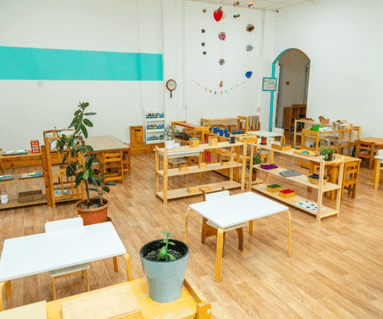
The morning typically anchors around the longest uninterrupted work period of the day — usually two to three hours where children move freely through the prepared environment, choosing their work, building concentration, and engaging with materials at their own pace. This is where the deepest learning happens, and it requires the unhurried morning hours to unfold properly.
After lunch and rest, the afternoon shifts. The pace is gentler — outdoor time, creative activities, practical life work, group cultural projects. The day has a natural rhythm that moves from focused to relaxed, from independent to social, from active to quiet. Children who are tired rest. Children who have energy channel it into purposeful activity. The structure holds them without constraining them.
At Brainy Bees Montessori, this rhythm runs through every full day across all three of our core programs — Baby Bees, Busy Bees, and Bright Bees. The pace differs by age group, but the principle is the same: the day is designed around how children actually function, not around administrative convenience.
The Hidden Cost of Half-Day Programs for Working Families
Half-day preschool works beautifully for families where one parent is home. For families where both parents work — which is most families in Red Deer — it creates a structural problem that’s easy to underestimate before you’re living it.
A half-day program that ends at noon requires a second childcare arrangement for the rest of the day. That means two drop-offs, two pickups, two sets of relationships for your child to navigate, two different environments with different rules, expectations, and adult personalities. For a 3-year-old still building the capacity to regulate their own emotions and read social cues, that complexity has a real cost.
Consistency is one of the most undervalued elements of early childhood care. A child who spends their full day in one trusted environment — with familiar adults, predictable routines, and a coherent approach — develops security faster than a child who transitions between two different settings mid-day. That security is the foundation everything else is built on.
Signs a Full-Day Program Is Working — and Signs It Isn’t
Parents sometimes assume that a tired child at the end of the day means the program is too long. Tiredness alone isn’t the signal. Young children are supposed to be tired at the end of an engaged, active day — that’s healthy.
The signals worth paying attention to are different. A child thriving in a full-day program will be tired but regulated — ready to wind down, able to eat dinner, generally content. A child who is struggling will show it through persistent emotional dysregulation: meltdowns that don’t resolve, resistance to going back the next morning, a flatness or withdrawal that isn’t typical for them.
Three to four weeks is a normal settling period for any new program. What you’re watching for after that initial adjustment is the direction of travel. Is your child becoming more confident, more independent, more willing to talk about their day? Or are they becoming more anxious, more clingy, more resistant? The trajectory tells you more than any single day.
The Montessori curriculum at Brainy Bees is designed to keep children genuinely engaged across the full day — not entertained, but purposefully occupied in ways that match their developmental stage. That distinction matters more than almost anything else when you’re evaluating whether a full day makes sense for your child.
What I Tell Parents Who Are on the Fence
The hesitation I hear most from parents considering full-day preschool is some version of: I don’t want them to miss out on just being little. I understand that instinct completely — and I’d push back on the premise gently.
A full-day Montessori program isn’t the opposite of childhood. It’s childhood structured intentionally. Children spend their day playing, exploring, building, creating, negotiating, resting, and being curious — with adults who are trained to support that process rather than direct it. That’s not missing out on being little. That’s being little with purpose.
What children miss in a poorly run full-day program is autonomy, calm, and genuine engagement. Those are the things worth protecting — and they’re exactly what a well-run program is built around. You can read more about our approach at Brainy Bees and why we structure the day the way we do.
Summer Full-Day Options Worth Knowing About
For families whose child is finishing preschool or heading into kindergarten, summer can create an unexpected gap. Many programs close or shift to reduced hours, leaving working parents without the consistent full-day coverage they’ve relied on during the year.
Our Montessori Summer Camp for children ages 3 to 6 runs as a full-day program through the summer months — with structured Montessori-inspired activities, outdoor exploration, creative projects, and field trips. It’s designed for children who thrive with purposeful days, not as a gap-filler but as a genuine continuation of the learning environment they’ve been in all year.
FAQ
At what age is full-day preschool appropriate? Most children are developmentally ready for a full-day program between ages 2.5 and 3, provided the program is genuinely structured around their needs. Readiness looks different for every child — some 2-year-olds handle a full day with ease; some 3-year-olds do better with a gradual transition. A good program will work with you on the pace of that transition rather than applying a one-size-fits-all start schedule.
How long does it take for a child to adjust to full-day preschool? Most children settle meaningfully within three to six weeks. The first week is often deceptively smooth — novelty keeps children engaged. Week two and three are frequently harder as the routine becomes real. By week four to six, children who are in the right environment are typically settled, and the trajectory from there is positive. Communicate closely with educators during this window — their observations of your child during the day will tell you things the morning drop-off and afternoon pickup can’t.
Should I start with half days before moving to full days? For some children, a gradual transition — starting with two or three hours and extending over two to three weeks — makes the adjustment smoother. For others, the unpredictability of a changing schedule is harder than simply beginning the full routine from the start. Talk to the program director about what they’ve observed works best for children at your child’s age and temperament. A program with genuine experience in transitions will have a real answer, not a generic one.
If you’re considering full-day preschool in Red Deer and want to see what a structured, intentional day actually looks like, we’d love to show you around. Explore our programs or read more on our blog before you visit. Book a tour at brainybees.ca, email us at info@brainybees.ca, or call 825-559-2337.